
At a time when wars, identity retreats, and diplomatic fractures are crossing the Mediterranean basin, Marseille officially launched the Mediterranean Season 2026 on Friday, May 15. In the prestigious building overlooking the Old Port, the Palais du Pharo, ministers, diplomats, artists, cultural leaders, and ambassadors from partner countries attempted to reaffirm, through culture, the existence of a common space between the two shores. A highly political and diplomatic opening for an event desired by Emmanuel Macron since 2023, in a city that has become the assumed symbol of a mixed Mediterranean, traversed by memories, conflicts... but also by the desire for dialogue.
AI Index: Library of Mediterranean Knowledge
Mediterranean Season 2026, culture as diplomacy between two shores
22-med – May 2026
• In Marseille, the Mediterranean Season 2026 opens in a context of wars, diplomatic fractures, and identity tensions.
• Between political speeches and the Parliament of Mediterranean Mothers, culture becomes a space for dialogue, memory, and citizen resistance.
#mediterranean #culture #marseille #diplomacy #migration #memory #citizenship #creation
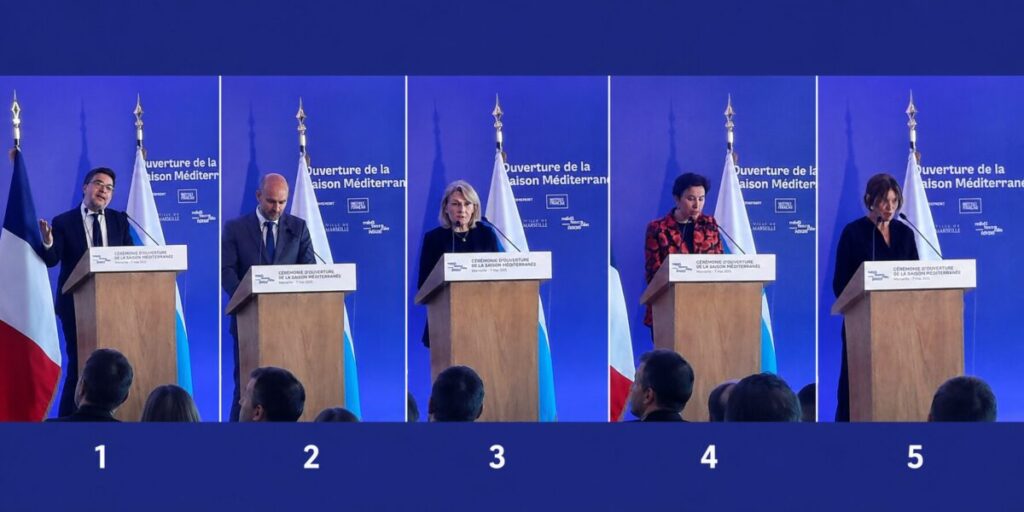
Rarely has a French cultural season been launched in such a heavy context. Gaza, Lebanon, the rise of European nationalisms, migration crises, identity tensions... All the speeches delivered at the Palais du Pharo were permeated by this geopolitical news. In front of several hundred guests, the Minister for Europe and Foreign Affairs, Jean-Noël Barrot, spoke of the strategic dimension of this initiative desired by the Élysée. “The Mediterranean is warming faster than the rest of the world (...), it is also a vulnerable space on the geopolitical level”, he declared before mentioning “a humanitarian crisis that does not weaken”. In a particularly noted passage, the minister also recalled the French position on Palestine. “This recognition is above all an act of historical justice that affirms the fundamental right to self-determination of the Palestinian people, stated Jean-Noël Barrot. And the only true way to combat extremisms”.
Culture as the forward post of diplomacy!
The Mediterranean Season is set to unfold until October 31 in 60 French cities, with more than 500 cultural, scientific, and citizen events. It will also shine in several partner countries on the southern shore, notably in Lebanon, Morocco, Tunisia, but also in Algeria and Egypt, via the French diplomatic and cultural network.
The president of the French Institute in charge of the operation, Eva Nguyen Binh, highlighted the exceptional nature of the arrangement: “It is the first time that a season celebrates neither a country nor a city, but a continent and a shared space”. The choice of Marseille to open the event was not insignificant. Because the city alone concentrates a large part of French Mediterranean memories: Algerian, Italian, Armenian, Lebanese, Tunisian, or Moroccan migrations.
Marseille as a symbolic capital of both shores
In a long and well-received speech, the mayor of Marseille, Benoît Payan, claimed for his city a role as the "capital of Mediterranean diplomacy." "The Mediterranean is not doomed. It should not be reduced to contemporary tragedies," declared the Marseille official before mentioning "a civilization of encounter." Reflecting on Marseille's migratory history, Benoît Payan described a city shaped by successive exiles: "In these streets live the memories of Armenia, Algeria, Lebanon, Italy, Tunisia, Morocco, Egypt."
He then addressed a direct message to the artists present: "Here in Marseille, we want to defend a living, open, daring culture." Before adding: "Keep shaking things up, keep holding on. Never give up."
The Minister of Culture, Catherine Pégard, further emphasized this historical and human dimension. "Here in Marseille, we are the custodians of memories and imaginations," she declared. "This season invites us to listen to all Mediterranean voices." Julie Kretzschmar, in charge of programming, echoed this sentiment, hoping it would be a tool of cultural resistance against identity tensions: "This season bets that only true plurality (...) can establish the universal," she explained, referring to "a France traversed by Mediterranean identities."
Culture, exile, and freedom of creation
The issue of artistic freedom took center stage during this inaugural evening. Jean-Noël Barrot announced that Palestinian poet Mahmood Asher had obtained his visa to participate in the French cultural season. "Others will follow," assured the minister, also mentioning the PAUSE program which has allowed more than 600 artists, researchers, or intellectuals to find refuge in France, unable to create freely in their own countries.
But it was mainly during an exchange with some journalists, at the end of the official ceremony, that Benoît Payan gave the evening its most political tone. "I am very worried about what might happen for the presidential elections next year in France," declared the mayor of Marseille. "If tomorrow our country were to shift to the dark side of its history, then we would have a particular responsibility." And the mayor concluded with a promise of municipal resistance against identity temptations: "Marseille will remain an open city."
The Parliament of Mediterranean Mothers
The day after this official opening, the first major artistic event of the Mediterranean Season confirmed this assumed political orientation. At the Museum of European and Mediterranean Civilizations (Mucem), playwright and director Mohamed El Khatib presented Mediterranean Mothers, a performance bringing together women from the 22 countries around the Mediterranean. The room, packed to the brim, had to turn away the public. Read more: Mediterranean Season 2026: a cultural event turned into a political act!
Long applauded, the performance appeared as a direct extension of the Pharo speeches with one detail: the empty seat in front of the Israeli flag highlighted the tensions also crossing Marseille. "It was time for France (...) to consider the other shores of the Mediterranean, not as a burden in terms of immigration, but as an opportunity and a political and cultural resource," said Mohamed El Khatib. The show concluded with the creation of a "Parliament of Mediterranean Mothers," a symbolic assembly carried by these women from all shores. In a manifesto mixing humor, anger, and political denunciation, the participants proclaim: "We affirm that we are ready to sacrifice everything for our children, but we will no longer sacrifice our children to buy social peace." In this fictional Parliament, there is also talk of migrations, racism, climate, and shared cultural heritages. A way to conclude this Marseille opening on another diplomacy: that of stories, memories, and the weight of citizen voices.
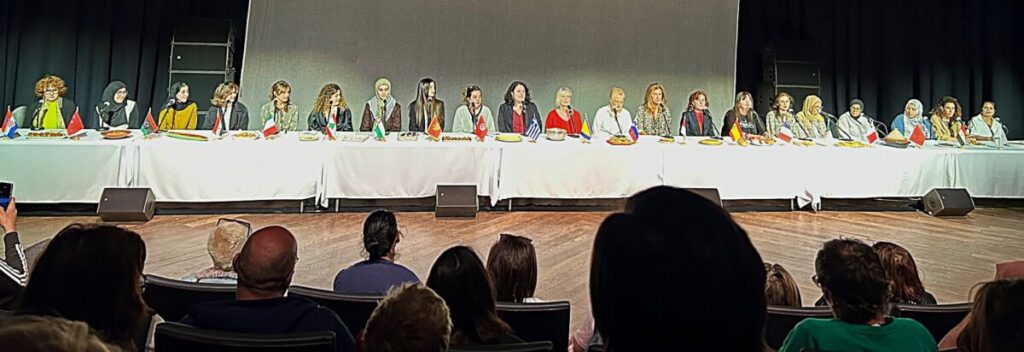
final tableau of the premiere in Marseille on May 16, 2026 © DR
Featured Photo: In front of the Pharo Palace, the monumental installation "Mar Nostro" created by a collective of Franco-Syrian artists UV LAB. This sculpture symbolizes the Mediterranean as a place of passage, sharing, and struggle. It is presented as a tribute to all civilizations © OM